AI vs Human Intelligence: What’s the Difference and What Lies Ahead?
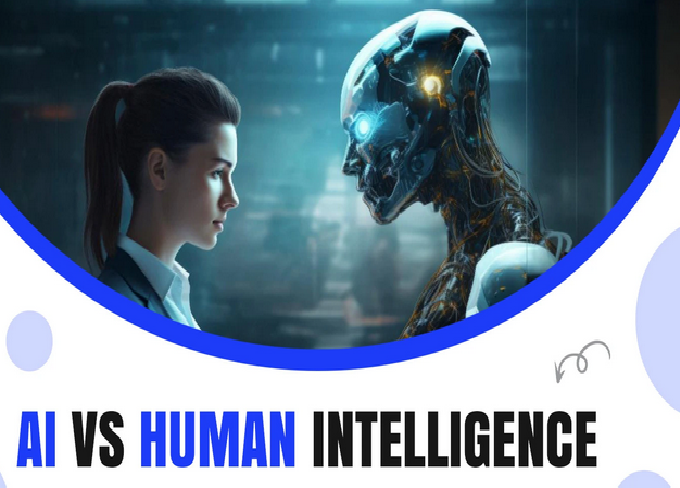
Artificial intelligence (AI) is no longer a science-fiction curiosity. It powers search engines, recommends what to watch, helps doctors read scans, and even writes (or co-writes) essays like this one. But how does AI actually compare to human intelligence? Are machines simply fast calculators, or do they possess something akin to human thought, creativity, or consciousness? This article unpacks the differences, explores strengths and weaknesses on both sides, and sketches plausible paths for the future — practical, ethical, and philosophical.
What we mean by “intelligence”
Before comparing AI and human intelligence, it helps to clarify what “intelligence” means. In everyday use the term bundles several abilities: learning from experience, solving novel problems, reasoning, planning, perceiving and interpreting the world, using language, and displaying creativity and social understanding. Humans show all of these in rich, flexible ways.
AI, by contrast, refers to systems built to perform tasks that typically require human intelligence. Today’s mainstream AI systems (often called “narrow AI” or “specialized AI”) are optimized for specific tasks: image recognition, language modeling, recommendation, planning, or game playing. The architectures and objectives vary — from neural networks that identify cats in photos to probabilistic models predicting user behavior — but they share a key property: they excel within a defined problem space but struggle outside it.
Core technical differences
1. Architecture and substrate
Humans run on wet biological hardware — neurons, glia, hormones — that evolved over hundreds of millions of years. This organic substrate is massively parallel, fault tolerant, and tightly linked to a body that senses and acts in the world.
AI runs on silicon and software. Modern AI uses mathematical models — notably artificial neural networks — that simulate some properties of biological neurons but are vastly simpler. Computers are excellent at precise arithmetic, memory retrieval, and running many operations per second; they lack the inherently embodied, homeostatic, and biologically driven aspects of human brains.
2. Learning style and data needs
Humans are data-efficient learners. A child can learn new words, physical skills, or social cues from relatively few examples and generalize broadly. Much of human learning is unsupervised or weakly supervised: we observe, imitate, and abstract regularities.
AI typically needs massive labeled datasets or extensive compute (though research in few-shot and self-supervised learning is closing the gap). Modern language models, for instance, learn from billions of words. They can generalize impressively within the distributions they’ve seen, yet they can fail spectacularly with out-of-distribution inputs or adversarial examples.
3. Flexibility and transfer
Human intelligence is highly flexible across domains: the same person can learn mathematics, compose music, and negotiate a business deal. Humans transfer knowledge across contexts, using analogies and common sense.
AI systems are generally narrow: a model trained to play Go cannot drive a car or diagnose disease without extensive re-training or reconfiguration. Transfer learning exists in AI, but it’s limited and brittle compared to human transfer.
4. Goals and motivation
Humans act according to layered motivations: survival drives, social incentives, curiosity, identity, and long-term projects. Motivation is entangled with physiology and social environment.
AI follows objective functions set by designers (loss functions, rewards). It optimizes those functions ruthlessly within constraints but lacks intrinsic goals unless engineered to mimic them. This difference influences behavior in ways that matter deeply when AI operates in open environments.
Strengths of AI
Speed and scale
Computers can process enormous datasets and execute trillions of operations per second. For tasks requiring pattern matching across massive data (search, classification, optimization), AI outpaces humans.
Precision and repeatability
AI operates without fatigue and can execute repetitive tasks consistently. In manufacturing, medical image screening, and logistics, that reliability yields clear benefits.
Handling high-dimensional data
AI can find patterns in spaces humans cannot intuitively parse — multivariate signals in genomics, subtle correlations in sensor arrays, or complex patterns in user behavior.
Augmentation potential
AI systems augment human capabilities: helping doctors interpret images, enabling designers to explore many options quickly, and automating routine tasks so humans can focus on high-value creative or interpersonal work.
Strengths of human intelligence
Common sense and contextual reasoning
Humans effortlessly use common sense: gravity works, objects fall, people have intentions. This world knowledge is broad and flexible. AI struggles with some simple physical or social inferences that humans find trivial.
Creativity with purpose
Humans create not just novel artifacts but contextually meaningful ones. We combine emotions, cultural knowledge, and long-term goals to produce art, arguments, and inventions that resonate with other humans.
Moral and social understanding
Human moral reasoning is messy but rooted in empathy, shared norms, and responsibility. We can deliberate on ethical tradeoffs, negotiate social contracts, and hold others accountable.
Embodiment and sensorimotor grounding
Human intelligence is grounded in bodily experience: balance, touch, embodied reasoning through actions. This sensorimotor integration influences cognition, learning, and perception in ways AI often lacks.
Shared limitations and pitfalls
Both AI and humans can exhibit biases, but their origins differ. Human biases stem from cognitive shortcuts, cultural upbringing, and emotional influences. AI biases typically reflect training data and objective function choices. AI can amplify systemic biases present in data at scale, creating sociotechnical risks.
Both can overfit: humans sometimes latch onto misleading patterns; AI can overfit training datasets and fail to generalize. Both can be manipulated (humans by persuasion and propaganda, AI by adversarial inputs).
Creativity, consciousness, and emotions: are they comparable?
Creativity
AI generates poems, images, and music that can astonish. But is that creativity equivalent to human creativity? AI recombines patterns learned from data; humans draw on subjective experience, cultural context, personal struggles, and intentionality. AI can be a powerful creative tool and collaborator, but whether it “understands” the meaning underpinning its creations is debatable.
Consciousness and subjective experience
Consciousness — the feeling of being — is a philosophical and scientific puzzle. There’s no evidence that current AI systems are conscious. They process inputs and produce outputs without subjective experience as far as we can observe. Many philosophers argue consciousness requires biological substrates or particular organizational properties; others think it might be possible in synthetic systems that mirror those properties. Right now, the conservative and practical stance is to treat AI as non-conscious tools.
Emotions
AI can mimic emotions (generate empathetic responses, recognize facial affect), but genuine feelings — the qualia of joy, sorrow, or shame — are rooted in biological processes and lived experience. AI simulations might be functionally useful (e.g., therapeutic chatbots) without implying internal feeling.
Practical consequences: jobs, education, and society
Jobs and labor
AI will reshape labor markets. Routine cognitive and manual tasks are most vulnerable to automation. But AI also creates new roles: AI system designers, ethicists, data curators, and jobs that require deep human skills (caregiving, nuanced negotiation, creative leadership). History shows technology displaces certain tasks while generating new economic opportunities; the transition, however, can be disruptive and uneven, requiring policy responses.
Education and skills
The growing importance of AI suggests education should emphasize complementary human skills: critical thinking, creativity, social and emotional intelligence, and lifelong learning. Technical literacy (understanding how AI works and how to use it responsibly) will also matter across disciplines.
Governance and ethics
AI raises policy questions: privacy, safety, fairness, liability, and concentration of power. Regulations, industry standards, and cross-stakeholder governance mechanisms are needed to manage risks while preserving innovation. Transparent auditing, documentation (model cards, datasheets), and human oversight are practical steps to increase accountability.
Collaboration: the near-term sweet spot
Rather than an either/or framing, a more useful lens is collaboration. Humans excel at setting goals, applying context, exercising moral judgment, and imagining futures. AI excels at pattern recognition, optimization, and scaling. Hybrid systems that pair human oversight with AI efficiency produce better outcomes than either alone across healthcare, law, science, and creative industries.
Examples include AI assisting radiologists to flag suspicious scans, editors using AI to draft articles then adding nuance, or artists using generative models to explore variations before applying human judgment. The partnership model also helps manage AI’s tendency to hallucinate or misinterpret — humans provide context and verification.
What lies ahead: plausible near-term scenarios
1. More powerful narrow AI, gradual integration
The most likely near-term path is continued improvement in narrow AI: better language models, more capable vision systems, and improved planning agents. These will be integrated into workflows across industries, improving productivity but requiring governance and reskilling.
2. Increasing autonomy with safety guardrails
Autonomous systems (self-driving vehicles, industrial automation, autonomous agents) will grow in capability. Ensuring safety, robustness, and ethical behavior becomes critical as systems operate with less human supervision.
3. Human-AI co-creativity
Tools that augment human creativity (co-writing, design assistants, music collaborators) will become mainstream. This can democratize creative expression but also challenge existing norms around attribution, originality, and value.
4. Emergent capabilities and surprise risks
AI research occasionally produces surprising emergent behaviors. Managing low-probability, high-impact risks (misuse, rapid capability jumps) requires proactive safety research, cross-industry collaboration, and international coordination.
Long-term philosophical possibilities
Speculation about artificial general intelligence (AGI) — systems with human-level general intelligence across domains — occupies both technologists and philosophers. If AGI were achievable, it raises profound questions: Can machines possess moral status? How would rights be assigned? What economic and societal structures would be needed?
Two cautionary points: first, timelines for AGI are highly uncertain and contested. Second, whether AGI would be “like” human intelligence depends on architecture, embodiment, and goals. Even if machines match human cognitive performance, they may differ in values and motivations in ways that matter deeply.
Principles for moving forward
-
Design for augmentation, not replacement: Prioritize AI that extends human capability and preserves human judgment in high-stakes domains.
-
Focus on robustness and interpretability: Build systems whose behavior can be understood, audited, and corrected.
-
Invest in education and transition support: Prepare workers with complementary skills and provide safety nets during transitions.
-
Govern proactively and globally: Align on standards for safety, transparency, and fairness that transcend borders.
-
Center human values: Keep human flourishing, dignity, and equity at the core of AI development.
Conclusion
AI and human intelligence are different in kind and in strength. AI brings speed, scale, and pattern-mining power; humans bring common sense, ethical judgment, emotional richness, and contextual understanding. The most fruitful path is collaboration: pairing the strengths of both to solve problems neither could solve alone.
The future will be shaped not solely by technological possibility but by human choices — how we design incentives, regulate systems, educate people, and define social priorities. If we focus on augmenting human potential, safeguarding rights, and distributing benefits fairly, AI can be a powerful tool for progress. If we neglect governance, equity, and human values, risks multiply. The challenge and opportunity ahead is to steward this powerful technology so that it amplifies what we most value about being human.






Post Comment