Best Programming Languages for Web Development in 2025
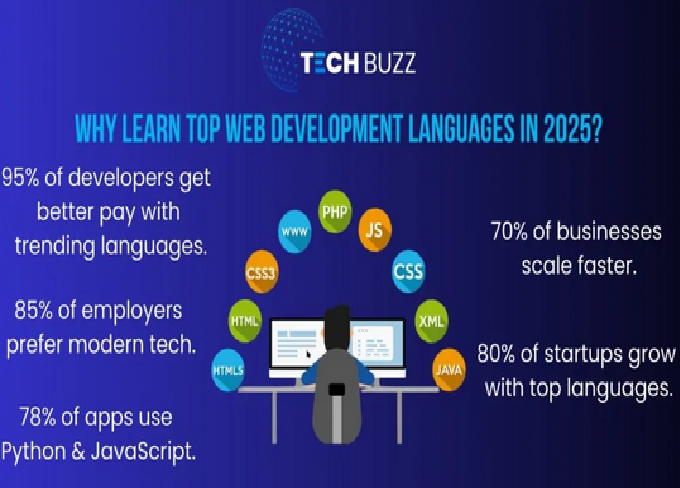
Web development is evolving faster than ever. In 2025, developers have access to a wide range of programming languages and frameworks that make building websites, applications, and online platforms more efficient and powerful. Whether you’re a beginner or a professional developer, choosing the right programming language is critical to achieving speed, scalability, and long-term success.
This article explores the best programming languages for web development in 2025, their features, benefits, and ideal use cases — helping you make an informed decision for your next project.
1. JavaScript and TypeScript — The King of Web Development
When it comes to web development, JavaScript continues to be the backbone of the web. Every browser supports it, and it remains essential for creating interactive and dynamic front-end experiences. However, in 2025, TypeScript, a superset of JavaScript, has become the standard choice for large-scale web applications.
Why Choose JavaScript/TypeScript
-
Runs directly in the browser — no plugins required.
-
Huge ecosystem of frameworks and libraries (React, Vue, Angular, Svelte).
-
TypeScript offers static typing, improving code quality and reducing errors.
-
Works perfectly for both front-end and back-end (Node.js, Deno, Bun).
Popular Frameworks
-
Front-End: React, Angular, Vue, Svelte
-
Full-Stack: Next.js, Remix, Nuxt.js, SvelteKit
-
Back-End: Node.js with Express, NestJS, or Fastify
Ideal Use Cases
-
Single Page Applications (SPAs)
-
Full-stack apps using one language
-
Real-time applications like chat or dashboards
2. Python — The All-Rounder for Back-End and AI Integration
Python has become one of the most versatile and developer-friendly languages in 2025. Its simplicity, readability, and extensive library ecosystem make it perfect for both beginners and professionals. It’s especially powerful for web applications that use AI or data analytics.
Why Choose Python
-
Easy to learn and maintain
-
Excellent for APIs and backend logic
-
Dominant language in AI, ML, and data science
-
Rich frameworks like Django and FastAPI speed up development
Popular Frameworks
-
Django: Ideal for full-featured web apps with built-in admin and ORM
-
Flask: Lightweight framework for simple apps or microservices
-
FastAPI: High-performance framework for APIs with async support
Ideal Use Cases
-
AI-driven web apps
-
RESTful and GraphQL APIs
-
Data-intensive dashboards
3. Go (Golang) — The Language of Performance and Simplicity
Go, developed by Google, has become the go-to choice for building scalable, high-performance backend services. Its simplicity, speed, and concurrency model make it perfect for cloud applications and microservices.
Why Choose Go
-
Compiles into a single fast binary — easy to deploy
-
Excellent concurrency using goroutines
-
Minimalistic design with high readability
-
Perfect for cloud-native, containerized environments
Popular Frameworks
-
Gin: Lightweight and fast HTTP framework
-
Fiber: Inspired by Express.js but optimized for Go
-
Echo: Simple and efficient for REST APIs
Ideal Use Cases
-
Cloud-based microservices
-
High-performance APIs
-
Real-time and streaming platforms
4. Rust — The Future of Safe and Fast Web Development
Rust is gaining massive popularity for its unmatched performance and memory safety. Although it has a steeper learning curve, it’s quickly becoming a top choice for developers building high-performance systems or using WebAssembly in the browser.
Why Choose Rust
-
High speed comparable to C++
-
Prevents memory leaks and crashes through safe memory management
-
Ideal for writing secure and reliable applications
-
Excellent integration with WebAssembly
Popular Frameworks
-
Rocket: Easy-to-use framework for web APIs
-
Actix Web: Blazing fast framework with async support
-
Axum: Modern, modular, and built for async performance
Ideal Use Cases
-
WebAssembly-based front-end performance modules
-
High-performance backend APIs
-
Security-critical web services
5. Java and Kotlin — The Enterprise Giants
Java has been a foundation of enterprise web development for decades. In 2025, it remains one of the most stable and scalable backend languages. Kotlin, on the other hand, brings modern syntax and safety features while being fully compatible with Java.
Why Choose Java/Kotlin
-
Mature ecosystem and massive community support
-
Excellent for large-scale enterprise systems
-
Robust frameworks like Spring Boot simplify development
-
Kotlin offers concise code and null safety
Popular Frameworks
-
Spring Boot: Most popular enterprise-level web framework
-
Micronaut: Lightweight alternative for microservices
-
Ktor (Kotlin): Flexible and developer-friendly
Ideal Use Cases
-
Large enterprise applications
-
Fintech and banking platforms
-
Scalable backend APIs
6. PHP — Still Relevant and Modernized
Despite being one of the oldest web languages, PHP continues to thrive in 2025, thanks to modern frameworks and its dominance in the CMS market. WordPress, which powers over 40% of the web, runs on PHP, and modern frameworks like Laravel have transformed its reputation.
Why Choose PHP
-
Simple and efficient for web projects
-
Huge hosting support and community
-
Excellent frameworks for rapid development
-
Great choice for small to medium-sized businesses
Popular Frameworks
-
Laravel: Modern, elegant, and full-featured
-
Symfony: Enterprise-grade and modular
-
CodeIgniter: Lightweight and fast
Ideal Use Cases
-
CMS and e-commerce websites
-
Dynamic content-driven sites
-
Small and medium business platforms
7. C# and .NET — The Corporate Powerhouse
C#, powered by .NET Core, has become a cross-platform language that works seamlessly on Windows, Linux, and macOS. In 2025, .NET’s ecosystem continues to offer one of the best frameworks for enterprise web applications and APIs.
Why Choose C# / .NET
-
Excellent performance and scalability
-
Rich set of tools and libraries
-
Great for building REST APIs and MVC applications
-
Integrates easily with Microsoft Azure and cloud services
Popular Frameworks
-
ASP.NET Core: High-performance framework for APIs and web apps
-
Blazor: Enables developers to build interactive web UIs using C# instead of JavaScript
Ideal Use Cases
-
Enterprise-level systems
-
Real-time applications using SignalR
-
Cross-platform backend services
8. Dart and Flutter Web — Unified Development for All Platforms
Dart, with Flutter, has revolutionized cross-platform development. In 2025, Flutter Web allows developers to build web, mobile, and desktop apps using a single codebase — saving time and cost while ensuring design consistency.
Why Choose Dart
-
One codebase for web, iOS, Android, and desktop
-
Highly responsive and beautiful UI components
-
Fast development with hot reload
-
Strong community and Google backing
Popular Framework
-
Flutter Web: Enables seamless UI and animations for all platforms
Ideal Use Cases
-
Startups building web + mobile products
-
Apps requiring rich, interactive UI
-
Rapid prototyping
9. Emerging Languages Worth Exploring
While the above are the most widely used, several new or specialized languages are making their mark in web development.
Elixir
-
Built for scalability and concurrency
-
Perfect for real-time apps and chat systems
-
Phoenix framework simplifies development
Swift (Server-Side)
-
Growing server-side usage
-
Perfect for teams already building iOS apps
WebAssembly (Wasm)
-
Not a language, but a technology allowing Rust, Go, or C++ code to run in the browser
-
Enables near-native performance on the client side
How to Choose the Right Language for Your Project
Selecting the best language isn’t just about popularity — it’s about your goals, resources, and the nature of your project. Here’s how to decide:
1. Project Type
-
Front-End UI → JavaScript/TypeScript
-
AI Integration → Python
-
High-Performance API → Go or Rust
-
Enterprise Platform → Java, C#, or Kotlin
-
CMS or Blogs → PHP
2. Team Expertise
Leverage the language your team is already comfortable with to reduce development time.
3. Ecosystem and Libraries
Check which language has the most mature tools for your requirements — for example, Django’s admin panel or Laravel’s ORM.
4. Performance Needs
Go and Rust lead in raw speed, while Python and JavaScript offer flexibility and rapid iteration.
5. Hiring and Community Support
Languages with large communities (JavaScript, Python, Java) make hiring easier and troubleshooting faster.
6. Long-Term Maintenance
Choose a language that offers stability, frequent updates, and backward compatibility.
Recommended Language Combinations (2025 Stacks)
| Project Type | Front-End | Back-End | Notes |
|---|---|---|---|
| SaaS Application | React + TypeScript | Node.js or Go | Fast, scalable full-stack solution |
| AI-Based App | Vue.js | Python (FastAPI) | Great for ML integration |
| E-Commerce | React or Angular | PHP (Laravel) or Java (Spring) | Reliable, secure, and customizable |
| Portfolio / Blog | Next.js | Node.js or PHP | Easy deployment and SEO-friendly |
| Enterprise App | React | C# (.NET Core) or Java | Robust and scalable |
| Cross-Platform App | Flutter Web | Dart | Single codebase for all platforms |
Future Trends in Web Development Languages
-
TypeScript Dominance: TypeScript will continue to replace plain JavaScript in large projects.
-
AI Integration: Python will remain strong for back-end and AI-related tasks.
-
WebAssembly Growth: Rust and Go will power heavy browser computations.
-
Serverless Adoption: Lightweight back-end frameworks (FastAPI, Next.js API routes) will dominate.
-
Cross-Platform Development: Dart and Flutter will keep gaining traction for unified development.
Conclusion
In 2025, web development isn’t about finding one best programming language — it’s about using the right tool for the right job. Each language has its strengths:
-
JavaScript/TypeScript — The universal choice for front-end and full-stack development.
-
Python — Ideal for back-end APIs, data-driven applications, and AI integrations.
-
Go — Perfect for performance and cloud-native services.
-
Rust — Best for safety, speed, and WebAssembly.
-
Java/Kotlin and C# — Still dominate enterprise solutions.
-
PHP — Excellent for CMS and content-heavy sites.
-
Dart (Flutter) — Future-proof solution for multi-platform UIs.
By understanding your project requirements, team skill set, and long-term goals, you can choose the perfect language or combination of languages to build powerful, scalable, and future-ready web applications in 2025.






Post Comment